Testosterone Replacement Therapy UK: TRT Treatment, Eligibility & Cost Guide
If you are considering testosterone replacement therapy (TRT) in the UK, understanding your symptoms, testosterone levels, eligibility and treatment costs is an important first step. TRT may help men with confirmed testosterone deficiency, but symptoms alone do not establish a diagnosis, so proper assessment and blood testing are essential before treatment.
In this guide, you will learn about TRT treatment in the UK, NHS and private routes, eligibility criteria, the cost of TRT, other treatment options, safety and fertility considerations, and what to expect from a TRT consultation.
If you want a thorough assessment and are considering testosterone replacement therapy in Preston, My Private Clinic offers a private Men’s Health consultation to work out which treatment suits your symptoms and whether TRT is an appropriate option for you.
Considering TRT? Book a private appointment at My Private Clinic in Preston.
A Closer Look at Testosterone Replacement Therapy:
Testosterone replacement therapy is a medical treatment designed to replace testosterone in men with diagnosed testosterone deficiency and a matching pattern of symptoms.
Testosterone therapy for men may be considered when:
- Testosterone levels are known to be low, and the aim of treatment is to restore testosterone to its natural physiological range.
- Hypogonadism in men has been diagnosed through repeated low testosterone blood tests.
It is important to note that TRT in the UK isn’t a cure for fatigue, ageing or persistent tiredness; it is a medical treatment that is recommended only after a comprehensive clinical assessment.
Could You Be Suitable for Testosterone Replacement Therapy?
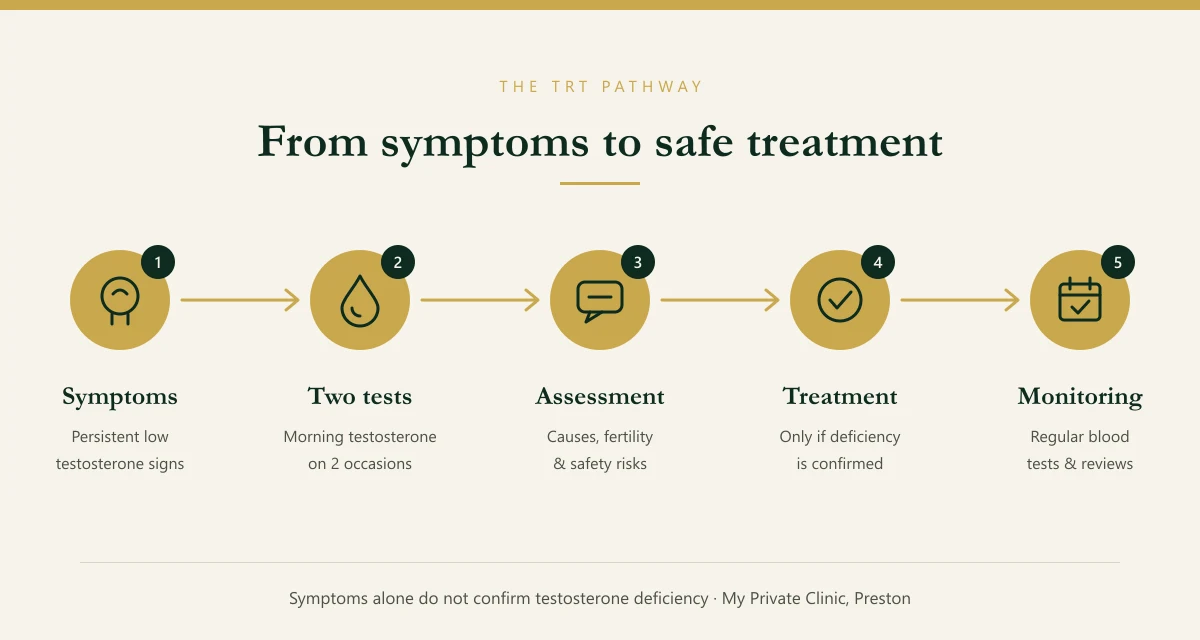
Before looking for treatment, it is essential to be clear about who is a candidate for TRT. In clinical practice, low testosterone symptoms alone cannot confirm hypogonadism; there need to be symptoms that don’t go away and consistently low morning testosterone levels on at least two separate occasions, according to the NIH.
Your GP may consider several factors before recommending TRT, including:
- Persistent low testosterone symptoms and their effect on your physical, sexual and emotional health.
- Low morning testosterone levels on repeated testing.
- SHBG and free testosterone levels, where medically appropriate.
- Your medical history and any underlying causes of low testosterone.
- Treatment safety risks and your fertility plans.
- According to guidelines, there is no single universal set of UK TRT requirements that confirms you qualify for TRT.
- 8–12 nmol/L is a borderline range that needs clinical interpretation, while levels consistently below 8 nmol/L, with symptoms, are strongly suggestive of hypogonadism.
TRT Treatment Methods: From Injections to Gels and Pellets:
When comparing the different types of TRT, there is no single best form that suits every man.
TRT is available as injections and gels, and the choice depends on:
- personal preference
- testosterone levels
- previous medical history
- the effects of treatment and how your body responds
| Testosterone Injections UK | Testosterone Gel UK |
|---|---|
| Formulations include Sustanon, Nebido and testosterone enantate. | Formulations include Testogel and Tostran. |
| It is an injectable form, and how often you inject TRT does not follow one fixed schedule. | It is applied directly to the skin. |
| The dosing interval depends on the formulation. | It can be applied to the skin daily, but daily use needs extra care to avoid transferring it to other people through skin contact. |
| Some injections are given every few weeks, while longer-acting formulations are given at longer intervals. | A good everyday option for people who want to avoid injections. |
Testosterone pellets UK:
This is a less common form of TRT. Your healthcare provider may discuss the availability of different types with you, so your treatment fits your needs.
- Review the testosterone therapy for hypogonadism guidelines to explore your options.
TRT or Other Options? Understanding Your Treatment Choices:
How low testosterone is managed depends heavily on why testosterone is low and the underlying cause. TRT isn’t the only treatment for testosterone deficiency; the choice also depends on factors such as preserving fertility and whether the cause is reversible.
TRT vs natural testosterone increase:
Lifestyle changes such as better sleep, physical activity, a healthy diet, stress management and weight control may help improve testosterone naturally, but they don’t replace TRT when testosterone deficiency has been diagnosed.
TRT vs testosterone boosters:
These are over-the-counter products and do not work in the same way as prescribed testosterone replacement therapy. If you have a medically confirmed deficiency, you shouldn’t rely on over-the-counter products.
TRT vs Clomid:
Clomiphene is a medicine that stimulates your body to produce its own testosterone. It is sometimes prescribed when the main goal is to preserve fertility and you have secondary hypogonadism.
NHS Testosterone Treatment: Can You Access TRT?
Yes. Testosterone replacement therapy (TRT) is available through the NHS, but access depends on persistent symptoms and a formal diagnosis of male hypogonadism. According to the NHS guideline on testosterone for male hypogonadism, key diagnostic criteria include:
- Biochemical confirmation through repeated tests showing low testosterone levels, with a clear pattern of symptoms.
- NHS GPs generally don’t start treatment; the process usually goes through specialists, who initiate treatment.
- NHS access depends on regional variation, local services and referral criteria.
NHS TRT Waiting Times
Waiting times generally depend on:
- Local access
- GP practices near you
- Availability of specialists and referral pathways
- Some patients wait months just to be assessed by a specialist.
So it’s better to check your local situation rather than rely on a national waiting-time figure.
Is TRT Safe? Side Effects and Potential Risks:
Some TRT side effects should be discussed before you decide whether to go ahead with treatment. Common side effects include:
- Emotional distress or changes in mood
- Fluid retention
- Acne and oily skin
- An increase in red blood cell concentration
- Skin irritation at the application site
- Potential transfer to another person, such as a partner or child (gel formulations)
TRT and Heart Health:
Men with a history of cardiovascular disease may need additional monitoring and closer evaluation of their risk factors.
TRT and Prostate Risk:
Prostate assessment is necessary before and during treatment; a significant rise in PSA may need further investigation.
Main contraindications to testosterone therapy:
- Locally advanced or metastatic prostate cancer
- Male breast cancer
- An active desire to have children
- Haematocrit above 54%
- Severe chronic heart failure (NYHA class IV)
Review the joint trust guidelines on adult testosterone replacement and monitoring to learn how testosterone deficiency in men is managed, including screening and ongoing monitoring.
TRT and Fertility: What Men Should Know:
If you are planning to have children, this is an important consideration. Taking testosterone from outside the body can suppress the brain’s signals to the testes, which can affect sperm production and significantly reduce your natural sperm count.
So if you are actively trying to conceive, TRT and sperm count need to be taken into account, because TRT may not be appropriate.
Does TRT Cause Infertility?
It can suppress fertility, often temporarily, but the recovery of sperm production after stopping TRT is uncertain and varies between individuals.
If you want to preserve fertility, there are specialised treatments that may be considered. See our Men’s Health page to discuss your concerns and treatment options in detail.
Private TRT & Cost Overview (UK 2026):
If you want to avoid long NHS waiting lists, private TRT treatment can give you flexibility, faster access and a direct appointment with a GP for a complete assessment.
Private TRT Treatment Costs:
The cost of private TRT is not just the monthly cost of treatment; it also covers the relevant diagnostic tests, monitoring and routine follow-up.
The average cost of TRT is between £100 and £200 per month, depending on the dose and medication.
At My Private Clinic, a Testosterone Replacement Therapy consultation starts from £119. Our pricing is transparent, so you know what to expect before you book. See our pricing page for details.
Your total cost will cover the following:
- Initial assessment and evaluation of your symptoms by our experienced GP.
- Private blood tests and other relevant diagnostic tests.
- Medication, depending on the type and how it is given.
- Monitoring for ongoing use and maintenance.
If cost is a concern and you are considering private care, look at the total cost, including appointments and tests, because the TRT cost per month in the UK differs between patients.
Getting TRT Privately at My Private Clinic, Preston
If you are thinking about testosterone replacement therapy in Preston, My Private Clinic offers a confidential private pathway for men who want to discuss possible testosterone deficiency and their treatment options.
What happens during your private GP consultation:
Stage 1: Discussion
We’ll discuss your ongoing symptoms, previous medical history, lifestyle, fertility goals and any concerns about your hormonal health and overall wellbeing.
Stage 2: Assessment
We’ll review whether private testosterone blood tests or further investigations (PSA / prostate blood tests) are needed to make a firm diagnosis, then, once the lab results are back, explain your treatment options and whether you need TRT or not.
Stage 3: Personalised Treatment Plan
You’ll receive a clear, personalised treatment plan based on your symptoms and test results. Where clinically appropriate, this may include GP-led testosterone replacement therapy in Preston, follow-up reviews and ongoing monitoring to help keep your treatment safe and effective.
Other options available at My Private Clinic include:
- Private GP appointments with ongoing support.
- Full Health MOT in Preston to identify any undiagnosed or untreated conditions, as a preventive assessment of your overall physical wellbeing.
- Private Blood Tests to evaluate any hidden metabolic changes that can cause excess fat, particularly visceral fat.
- Thyroid Function Tests, because an under- or overactive thyroid may cause weight changes.
- Diabetes test where clinically appropriate.
- Private blood pressure check and ECG if your GP considers a heart health assessment necessary.
- Well-Woman Health Checks for a detailed medical review of general health and risk factors.
- Women’s hormone blood tests to evaluate PCOS, as hormone imbalances can cause central obesity.
Visit our full services page.
FAQs:
Is TRT Addictive?
TRT is not considered addictive in the way substances such as opioids or recreational drugs are. However, your body can become dependent on externally supplied testosterone, meaning natural testosterone production may remain suppressed while you are taking it. Treatment should therefore be stopped or changed only with medical guidance.
Does TRT Cause Hair Loss?
TRT may accelerate hair loss in men who are genetically predisposed to male-pattern baldness, because testosterone can be converted into dihydrotestosterone (DHT). This does not mean every man taking TRT will experience hair loss.
Can You Build Muscle Faster on TRT?
TRT may improve muscle mass and strength in men who have genuinely low testosterone, particularly when deficiency has affected body composition. However, medically prescribed TRT is intended to restore testosterone to a physiological range, not to provide the supraphysiological doses associated with bodybuilding.
Does TRT Affect Mood?
It can. Some men with confirmed testosterone deficiency report improvements in mood, energy or wellbeing after treatment. However, mood changes have many possible causes, so TRT should not be used to treat unexplained mood symptoms without appropriate assessment.
How Long Does TRT Take to Work?
The timeframe varies depending on the individual and the symptom being treated. Some men may notice changes in libido or energy within weeks, while improvements in muscle mass and body composition can take several months. Treatment should be monitored over time rather than judged after only a few weeks.
Can TRT Cause Acne?
Yes. Increased testosterone activity can stimulate oil production and may cause or worsen acne in some men. If this occurs, your clinician can review the treatment and discuss appropriate management.
Does TRT Increase Red Blood Cells?
Yes, TRT can increase haematocrit and red blood cell production. This is one reason regular blood monitoring is an important part of treatment.
Can TRT Make You Gain Weight?
TRT is not generally prescribed as a weight-loss treatment. In men with confirmed testosterone deficiency, treatment may improve body composition by supporting muscle mass and potentially reducing fat mass, but individual results vary.
Can TRT Improve Libido?
Reduced libido is one of the symptoms associated with testosterone deficiency. Men with confirmed low testosterone may experience an improvement in sexual desire after treatment, although libido can also be affected by relationships, mental health, medications and other medical conditions.
Can I Start TRT Without Symptoms?
TRT is generally intended for men with both compatible symptoms and confirmed testosterone deficiency, rather than simply treating a low laboratory result in isolation. A clinician should assess whether treatment is appropriate for your individual circumstances.
Interested in TRT in Preston? Take the Next Step:
For men with low testosterone symptoms who are looking for a TRT clinic in Preston or considering private TRT in the UK, choosing a qualified provider is the first step towards the right guidance for your health.
Dr Faizal Secretary, an experienced GMC-registered GP at My Private Clinic, offers private consultations. You’ll receive a thorough medical evaluation, individualised treatment recommendations and ongoing support to help you achieve your health goals in a safe, sustainable way.
Book a private GP consultation in Preston to discuss your symptoms and find out whether testosterone replacement therapy is the right treatment for you.
Appointments are available:
- Face-to-face at our private GP clinic in Fulwood
- Online GP consultations in Preston
- Same-day appointments where available
- Private GP home visits where clinically appropriate in Fulwood and Preston
No registration is required. With your consent, we can also access your NHS records, and you remain registered with your NHS GP.